
Tools to Keep In Your Trunk
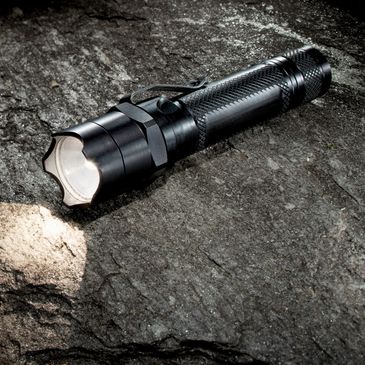
LED Flashlight
Small Battery Jump Pack
Small Battery Jump Pack
An LED flashlight is one of the most basic emergency tools every driver should keep in their trunk.
Car problems do not always happen during the day. You may get a flat tire, dead battery, warning light, or other problem at night. A flashlight helps you see what you are doing and stay safer around your vehicle.
Why Keep an LED Flashlight in
An LED flashlight is one of the most basic emergency tools every driver should keep in their trunk.
Car problems do not always happen during the day. You may get a flat tire, dead battery, warning light, or other problem at night. A flashlight helps you see what you are doing and stay safer around your vehicle.
Why Keep an LED Flashlight in Your Car?
An LED flashlight can help you:
- See under the hood at night.
- Find your battery terminals.
- Inspect a flat or damaged tire.
- Find your jack, spare tire, and tools.
- See underneath the vehicle.
- Look for leaks or visible damage.
- Find dropped lug nuts, bolts, or tools.
- Signal for help during an emergency.
- Make yourself more visible on the side of the road.
Why Choose LED?
LED flashlights are a great choice for your emergency trunk kit because they are bright, energy efficient, affordable, and long lasting.
Many LED flashlights can run for hours on a set of batteries. Rechargeable LED flashlights are another good option, but remember to check and recharge them regularly.
Safety Tip
If your vehicle breaks down at night, visibility is extremely important.
Move your vehicle to a safe location whenever possible, turn on your hazard lights, and stay away from moving traffic.
Never depend on your phone flashlight as your only source of light. Your phone battery may already be low when you need it most.
Dirty Junky Car Tip
Keep a small LED flashlight in your trunk at all times. Check the batteries occasionally and make sure the flashlight works before a road trip.
A flashlight may be a simple and inexpensive tool, but when your car breaks down after dark, you will be glad you have one.
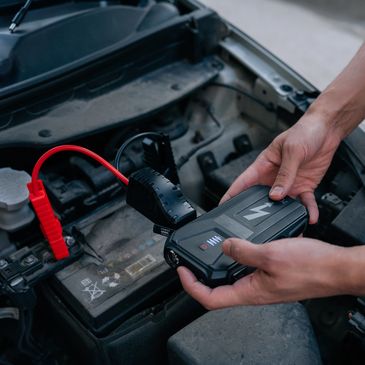
Small Battery Jump Pack
Small Battery Jump Pack
Small Battery Jump Pack
A small battery jump pack is one of the most useful emergency tools you can keep in your trunk.
If your car battery becomes weak or dead, a portable jump pack may help you start your vehicle without needing another car.
Why Keep a Battery Jump Pack in Your Car?
A small portable jump pack can help when:
- Your battery suddenly dies.
- You accidenta
A small battery jump pack is one of the most useful emergency tools you can keep in your trunk.
If your car battery becomes weak or dead, a portable jump pack may help you start your vehicle without needing another car.
Why Keep a Battery Jump Pack in Your Car?
A small portable jump pack can help when:
- Your battery suddenly dies.
- You accidentally leave your lights on.
- Your battery becomes weak in cold weather.
- Your vehicle has been sitting for a long time.
- Nobody is nearby to give you a jump-start.
- You are stranded in a parking lot or away from home.
Why Use a Portable Jump Pack?
Traditional jumper cables require another vehicle.
A battery jump pack has its own internal battery, allowing you to jump-start your vehicle by yourself when used correctly.
Many small jump packs are compact enough to fit inside your trunk emergency kit. Some models also include an LED flashlight and USB charging ports for emergencies.
Safety First!
Always read and follow the instructions included with your specific jump pack.
Make sure you connect the clamps to the correct battery terminals.
RED clamp = Positive (+)
BLACK clamp = Negative (-) or the connection point specified by the vehicle/jump-pack manufacturer.
Never reverse the connections. Incorrect connections can cause sparks, electrical damage, battery damage, or personal injury.
Do not use a jump pack on a battery that is swollen, leaking, cracked, frozen, or visibly damaged.
Keep It Charged
A jump pack will not help if its internal battery is dead.
Check the charge level regularly and recharge it according to the manufacturer's instructions.
Before taking a long road trip, make sure your jump pack is fully charged and ready to use.
Dirty Junky Car Tip
You do not necessarily need a huge or expensive jump pack for your emergency trunk kit. Look for a compact portable jump starter that is properly rated for your vehicle's engine size.
Keep it charged, learn how to use it before an emergency happens, and store it according to the manufacturer's temperature and safety instructions.
A small battery jump pack can turn a dead battery into a minor inconvenience instead of leaving you stranded.
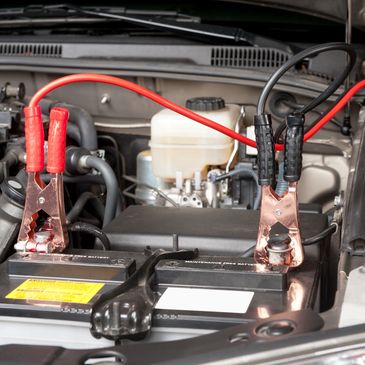
Jumper Cables
Small Battery Jump Pack
Small Portable Tire Inflator
Jumper cables are a basic emergency tool every driver should consider keeping in their trunk.
If your car battery becomes weak or dead, jumper cables may help you start your vehicle using another vehicle with a good battery.
Why Keep Jumper Cables in Your Car?
Jumper cables can be useful when:
- Your car battery suddenly dies.
- You accidentally l
Jumper cables are a basic emergency tool every driver should consider keeping in their trunk.
If your car battery becomes weak or dead, jumper cables may help you start your vehicle using another vehicle with a good battery.
Why Keep Jumper Cables in Your Car?
Jumper cables can be useful when:
- Your car battery suddenly dies.
- You accidentally leave your lights on.
- Your battery becomes weak.
- Your vehicle has been sitting for a long time.
- Your portable jump pack is dead or unavailable.
- Another driver needs help with a dead battery.
How Do Jumper Cables Work?
Jumper cables temporarily connect a vehicle with a good battery to a vehicle with a weak or dead battery.
The cables have two colors:
RED = Positive (+)
BLACK = Negative (-)
The correct connection procedure matters. Always follow your vehicle owner's manual because some vehicles have special jump-start terminals or procedures.
Safety First!
Using jumper cables incorrectly can be dangerous.
Never allow the red and black clamps to touch each other while connected to a battery.
Never reverse the positive and negative connections.
Incorrect connections can cause sparks, blown fuses, electrical system damage, battery damage, fire, or personal injury.
Never attempt to jump-start a battery that is cracked, leaking, swollen, frozen, or visibly damaged.
Keep the cables away from moving engine parts such as belts, pulleys, and cooling fans.
Jumper Cables vs. Battery Jump Pack
A portable battery jump pack can start a vehicle without another car nearby.
Jumper cables require another vehicle or suitable power source, but they are still an excellent backup because they do not have an internal battery that needs to stay charged.
Keeping both jumper cables and a small battery jump pack in your trunk gives you another option during a dead-battery emergency.
Dirty Junky Car Tip
Buy a decent set of jumper cables that are long enough to comfortably reach between two vehicles and appropriate for your vehicle.
Do not wait until you are stranded to learn how to use them.
Read your owner's manual, understand the correct connections, and keep your jumper cables neatly stored in your trunk.
They are inexpensive, simple, and could help get you back on the road when your battery lets you down.
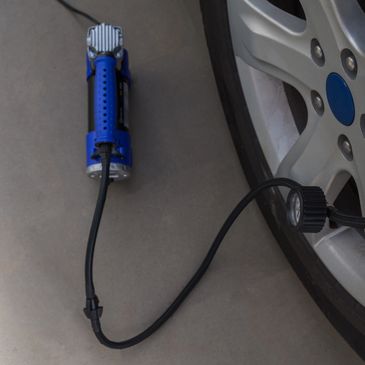
Small Portable Tire Inflator
Factory Jack & Tire Iron Tool
Small Portable Tire Inflator
A small portable tire inflator is a simple emergency tool that every driver should consider keeping in their trunk.
If one of your tires becomes low on air, a portable tire inflator may help you add enough air to safely address the situation or reach a nearby tire shop, depending on the condition of the tire.
Why Keep a Portable Tire Inflat
A small portable tire inflator is a simple emergency tool that every driver should consider keeping in their trunk.
If one of your tires becomes low on air, a portable tire inflator may help you add enough air to safely address the situation or reach a nearby tire shop, depending on the condition of the tire.
Why Keep a Portable Tire Inflator in Your Car?
A small tire inflator can be useful when:
- Your tire pressure is low.
- Your TPMS warning light comes on.
- A tire slowly loses air.
- Tire pressure drops during cold weather.
- You need to adjust tire pressure before a road trip.
- You are far away from a gas station or air pump.
How Does a Portable Tire Inflator Work?
Most small portable tire inflators connect to your vehicle's 12-volt power outlet, battery, or use a rechargeable internal battery.
Connect the air hose to the tire valve stem, check the recommended tire pressure, and inflate the tire according to the inflator manufacturer's instructions.
Many portable inflators also have a built-in digital tire pressure gauge and automatic shutoff.
What Tire Pressure Should You Use?
Always use the tire pressure recommended by the vehicle manufacturer.
You can usually find the recommended tire pressure on the sticker inside the driver's door jamb or in your owner's manual.
Do not automatically inflate the tire to the maximum PSI printed on the tire sidewall. That number is not necessarily your vehicle's recommended operating pressure.
Safety First!
A portable tire inflator is not a repair for a damaged tire.
Do not continue driving on a tire that has:
- Sidewall damage.
- A large puncture.
- Exposed cords.
- A bulge or bubble.
- Severe cracking.
- Major air loss.
- Visible structural damage.
If a tire will not hold air, stop driving and have the tire properly inspected.
Never crawl underneath a vehicle supported only by a jack.
Dirty Junky Car Tip
You do not need a huge air compressor for basic roadside emergencies. A small portable tire inflator can easily fit in your trunk and may save you a trip to the gas station.
Check it occasionally to make sure it works, keep rechargeable models charged, and learn how to use it before you actually need it.
A low tire can happen anywhere. Having your own portable tire inflator gives you the able to make to you next destination.
Small Basic Socket Set
Factory Jack & Tire Iron Tool
Factory Jack & Tire Iron Tool
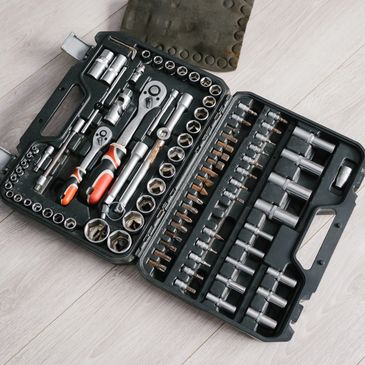
A small basic SAE and metric socket set is one of the most useful tools you can keep in your trunk.
You do not need a huge professional mechanic tool set for roadside emergencies. A small, inexpensive socket set can handle many basic automotive tasks and minor repairs.
Why Keep a Small Socket Set in Your Car?
A small basic SAE and metric socket set is one of the most useful tools you can keep in your trunk.
You do not need a huge professional mechanic tool set for roadside emergencies. A small, inexpensive socket set can handle many basic automotive tasks and minor repairs.
Why Keep a Small Socket Set in Your Car?
A basic socket set may help you:
- Remove and replace a car battery.
- Tighten or remove battery terminals.
- Replace certain headlight or taillight bulbs.
- Remove an engine air filter housing.
- Remove small brackets and covers.
- Tighten loose nuts and bolts.
- Perform basic brake repairs when properly equipped and trained.
- Handle other simple automotive repairs.
SAE and Metric
Look for a small combination set that includes both SAE and metric sockets.
Metric sockets are commonly used on modern vehicles.
SAE sockets are measured in fractions of an inch and may be found on some vehicles, accessories, trailers, and aftermarket parts.
Having both gives you more options without carrying a large toolbox.
What Should a Basic Socket Set Include?
For a simple trunk emergency kit, look for a compact set with:
- 1/4-inch and/or 3/8-inch ratchet.
- Common metric sockets.
- Common SAE sockets.
- A few deep sockets.
- Short extension.
- Basic screwdriver bits or driver.
- Small storage case.
You do not need hundreds of pieces. The goal is to have just enough tools for basic repairs and emergencies.
Safety First!
A socket set does not make every repair safe to perform on the side of the road.
Never attempt a repair next to moving traffic if you cannot safely move the vehicle away from the roadway.
Never work underneath a vehicle supported only by a jack. Always use properly rated jack stands on a stable surface when the repair requires working underneath a raised vehicle.
For brake repairs, use the correct tools, procedures, torque specifications, and safety equipment.
Dirty Junky Car Tip
Keep a small SAE and metric combination socket set in your trunk instead of carrying your entire toolbox.
You can find inexpensive compact sets online that are small enough to stay in your emergency kit.
You may not rebuild an engine on the side of the road, but you might need to change a battery, replace a bulb, remove an air filter housing, tighten a loose bolt, or perform another basic repair.
Sometimes a small socket set is all you need to get the job done.
Factory Jack & Tire Iron Tool
Factory Jack & Tire Iron Tool
Factory Jack & Tire Iron Tool
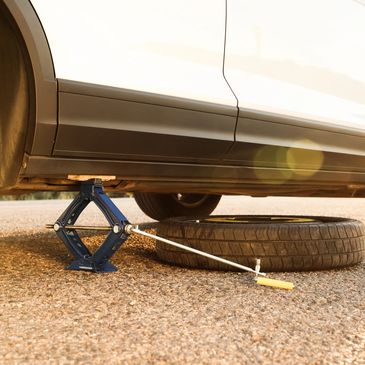
Most vehicles originally come with a factory scissor jack and tire iron. They are usually stored in the trunk near the spare tire or underneath the cargo floor.
These are basic emergency tools designed primarily to help you change a flat tire.
What Is a Factory Scissor Jack?
A factory scissor jack is a small mechanical jack designed to lift
Most vehicles originally come with a factory scissor jack and tire iron. They are usually stored in the trunk near the spare tire or underneath the cargo floor.
These are basic emergency tools designed primarily to help you change a flat tire.
What Is a Factory Scissor Jack?
A factory scissor jack is a small mechanical jack designed to lift one corner of the vehicle high enough to remove and replace a wheel.
It is compact and convenient, but it can also be dangerous if used incorrectly.
WARNING: Factory Scissor Jacks Can Be Dangerous!
A factory scissor jack should generally be treated as an emergency tire-changing tool — not a repair jack.
- Use it only at the manufacturer's designated jacking points.
- Park on a firm, level, stable surface whenever possible.
- Put the vehicle in Park or in gear for a manual transmission.
- Set the parking brake.
- Chock the appropriate wheel if possible.
- Keep passengers away from the vehicle while it is lifted.
- Never place any part of your body underneath the vehicle.
- Never crawl underneath a vehicle supported only by a scissor jack.
DO NOT use a factory scissor jack for major automotive repairs.
If you need to work underneath a vehicle, use properly rated lifting and support equipment and follow the correct safety procedures.
What Is the Factory Tire Iron?
The factory tire iron, also called a lug wrench, is used to loosen and tighten the wheel's lug nuts.
It is commonly stored with the factory jack and spare tire.
Before lifting the vehicle, the lug nuts are typically loosened slightly while the tire is still touching the ground. Do not completely remove them yet.
After installing the wheel, the lug nuts should be tightened in the proper sequence and ultimately tightened to the vehicle manufacturer's specified torque with a torque wrench.
Check Your Trunk Today
Do not assume these tools are still inside your vehicle.
If you purchased a used car, the factory jack, tire iron, spare tire, or other emergency equipment may be missing.
Check your trunk and make sure you have:
- The factory jack.
- The factory tire iron/lug wrench.
- The spare tire, if your vehicle was equipped with one.
- Any special wheel-lock key your vehicle requires.
- Your owner's manual or access to the manufacturer's tire-changing instructions.
Dirty Junky Car Tip
The factory scissor jack and tire iron are emergency tools, not professional repair equipment.
Use the factory jack to change a tire as directed by the vehicle manufacturer.
Never use a factory scissor jack to perform major repairs or crawl underneath your vehicle.
A car can be replaced.
Your life CAN NOT be replaced!